The Antipodes of the Mind - Charting the Phenomenology of the Ayahuasca Experience
Early chapters exploring the psychological, chemical, and cultural foundations of the Ayahuasca experience. In these opening chapters, the author approaches Ayahuasca not just as an exotic cultural artifact, but as a serious subject for cognitive psychology.
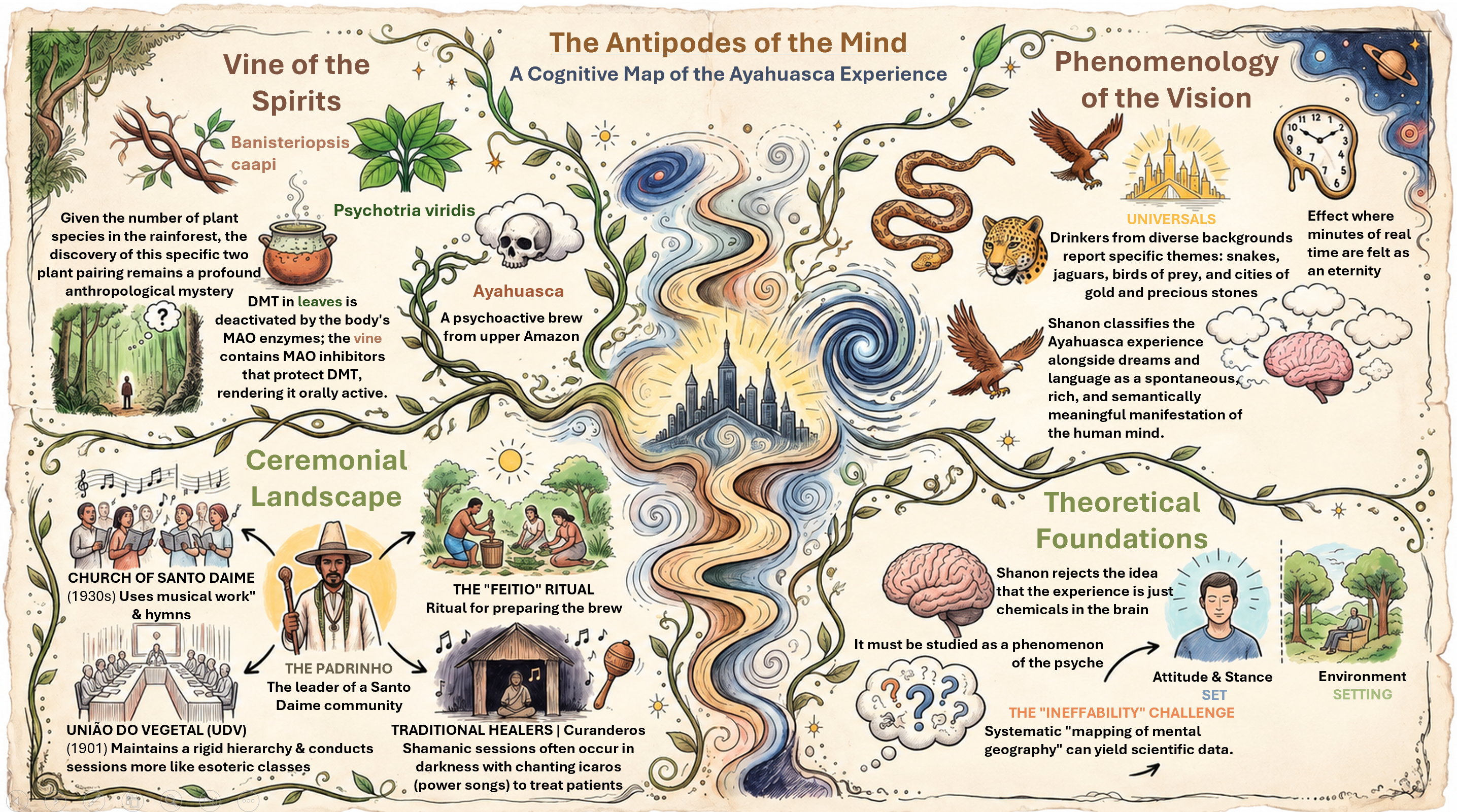
- The Personal Encounter & Psychological Riddles The author initially felt that seeing specific animals like snakes and jaguars seemed too specific to define cognitive universals. Despite the lack of formal teachers or textbooks in these rituals, there was definitely structure and order to the experience. The brew forces profound self-analysis where one is cruelly confronted with one’s self and one finds oneself having no other option but to address difficult internal issues. This intense internal journey ultimately shifted the author from identifying as a devout atheist to acknowledging a spiritual reality.
- Botanical Synergies & Cultural Roots Early academic groundwork for studying the brew was laid by figures like Richard Evans Schultes and Reichel-Dolmatoff. For indigenous peoples across the Amazon, Ayahuasca has long been a key constituent of culture. It alters consciousness profoundly, perhaps more completely than even peyote. The brew is typically made from two plants: Banisteriopsis caapi (often characterized as male) and Psychotria viridis (characterized as female). Its quality is affected by variations in the vine itself, including the wood’s distance from the root, its size, age, freshness, and the like. Chemically, it relies on N,N-Dimethyltryptamine or DMT combined with MAO (mono-amine oxidase) inhibitors like harmine, harmaline, and tetrahydroharmine. These inhibitors protect the DMT from breaking down in the stomach and thus render it orally active. Therefore, the plants must be combined so that both DMT and MAO inhibitors are present. The first written report of this brew came from the Ecuadorian civil servant Villavicencio. Traditional consumption requires a strict diet involving rigid restrictions on what foods may and may not be eaten, as well as sexual abstention, for days before and after the session.
- Ritual, Healing, and Modern Shifts Traditional healing sessions are typically conducted in complete darkness and involve only one serving of the brew. In modern clinical settings, the brew is sometimes utilised for the treatment of drug addicts alongside group psychotherapy sessions. Legally speaking, within indigenous contexts and modern syncretic religious groups in the Amazon, its use is legal. When discussing terminology, the author prefers neutral terms, noting that the word psychedelic simply means mind expanding.
- A New Cognitive Frontier Ultimately, the true puzzles of Ayahuasca pertain to the human psyche and the phenomenon of consciousness. A cognitive psychologist looks for the common structures and mechanisms of the mind, treating elements like language and memory as mental organs. The author views the visions as an uncharted natural cognitive domain. Similar to how modern linguistic science studies syntax, phonology, and semantics in spontaneous trains of mentations, the author aims to study the structure of these visions. The book also explores whether there are regularities in the progression of the visions and if distinct stages can be defined. The experience is deeply affected by questions of dynamics, contextual ones, past experience, and what researchers call ‘setting’ and ‘set’. A major goal is to determine if the phenomena are manifestations of a small set of psychological factors or not. This requires interpersonal comparisons to see if there are commonalities among people from different backgrounds, cultural or otherwise. Drawing on historical precedents like William James and Aldous Huxley’s writings on mescaline, the author argues that any comprehensive theory of cognition has to encompass both the ordinary and the non-ordinary facets of the mind. While respecting the mysterious nature of the Ayahuasca experience, the author approaches it as a Western student of cognition to push back against the claim that such altered states are entirely ineffable.
Next Book
Content